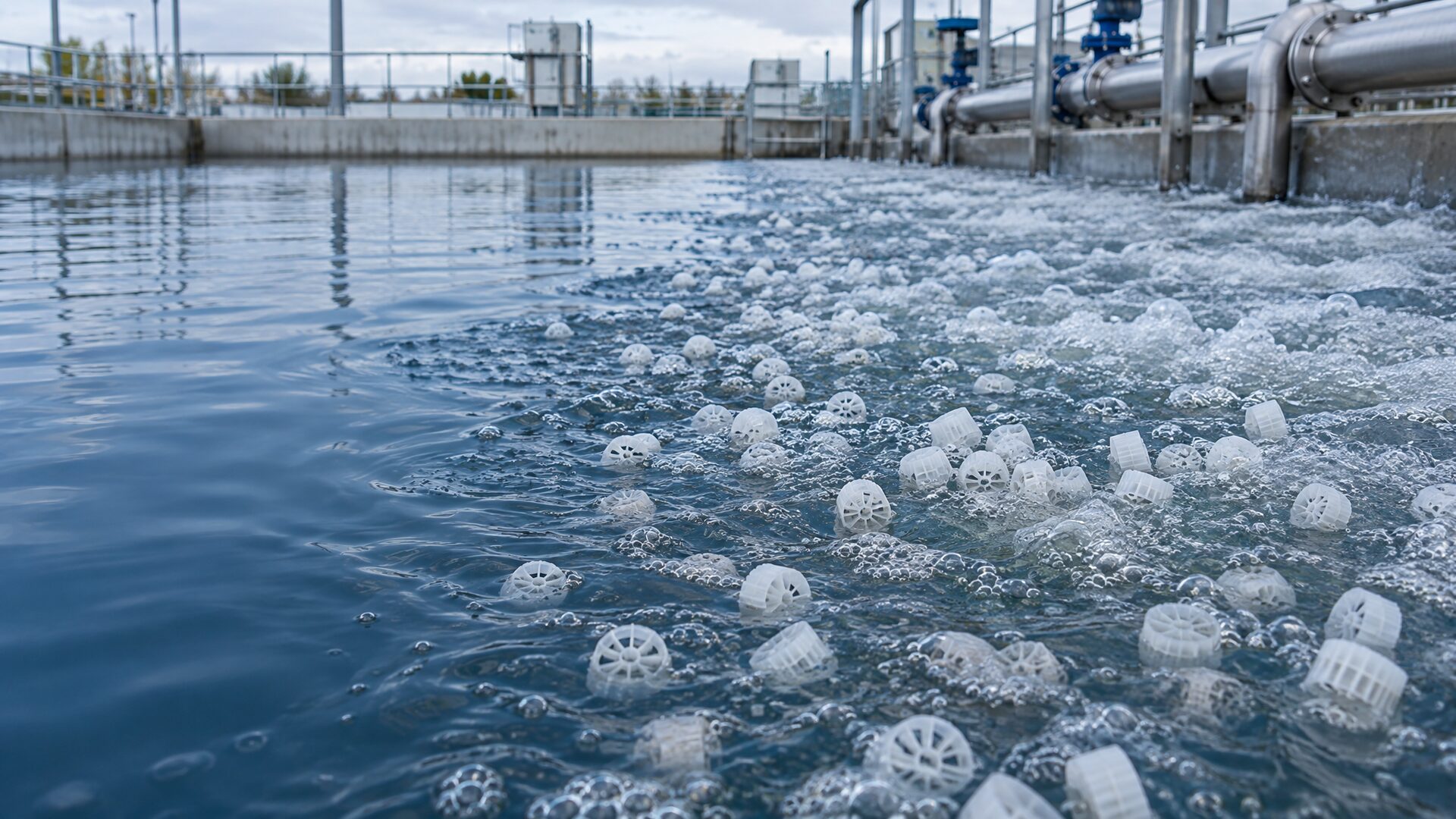
Aeration serves two essential functions in an aerobic MBBR: oxygen transfer to the biofilm and carrier mixing. Because aeration typically accounts for 50–70 % of total plant energy use, optimising blower control and diffuser performance directly impacts operational cost. This page focuses on day-to-day aeration management — for aeration system sizing, see the companion design page.
Blower control
Modern MBBR plants use variable-frequency drives (VFDs) on blowers, modulated by a PID loop reading the reactor DO probe. This approach matches air supply to oxygen demand in real time, avoiding both under-aeration (poor treatment) and over-aeration (wasted energy, excess shear). In multi-stage systems, each reactor should have independent airflow control because oxygen demand decreases along the treatment train.
A common pitfall is operating the blower at a fixed speed for simplicity. This guarantees inefficiency: at low load (nights, weekends) far more air is delivered than needed, while at peak load the fixed output may not be enough. VFD control with DO feedback eliminates this mismatch.
Diffuser maintenance
MBBR systems almost universally use coarse-bubble diffusers (not fine-bubble) because fine-bubble membranes are easily damaged by carrier abrasion and do not contribute to carrier mixing. Coarse-bubble diffusers are robust but still require periodic inspection: check for blocked orifices, uneven bubble distribution, and back-pressure increases that indicate fouling or scaling. A rising blower discharge pressure at constant airflow is the clearest sign of diffuser deterioration.
Aeration benchmarks
Indicative aeration data (confirm per project)
| Parameter | Typical Value | Unit | Notes |
|---|---|---|---|
| Aeration share of total energy | 50–70 | % | Largest single energy consumer. |
| Diffuser type | Coarse-bubble | — | Robust against carrier abrasion. |
| Blower control | VFD + DO PID | — | Standard best practice. |
| Minimum airflow constraint | Mixing requirement | — | May govern at low organic load. |
Energy optimisation tips
Beyond VFD control, operators can reduce aeration energy by: (1) lowering the DO setpoint as far as treatment allows — even 0.5 mg/L reduction can save significant energy; (2) cleaning or replacing diffusers on schedule to maintain low back-pressure; (3) ensuring that the inlet air filter is clean (a dirty filter increases blower suction losses); and (4) optimising the aeration pattern to avoid unnecessary over-aeration in downstream reactors where the load is already low.
Frequently Asked Questions
Why does MBBR use coarse-bubble diffusers instead of fine-bubble?
How can I tell if my diffusers need maintenance?
What is the biggest aeration energy saving opportunity?
Related Pages
Need MBBR Design Support?
Submit your wastewater data for a preliminary MBBR engineering assessment. Our team reviews every submission within 2 business days.