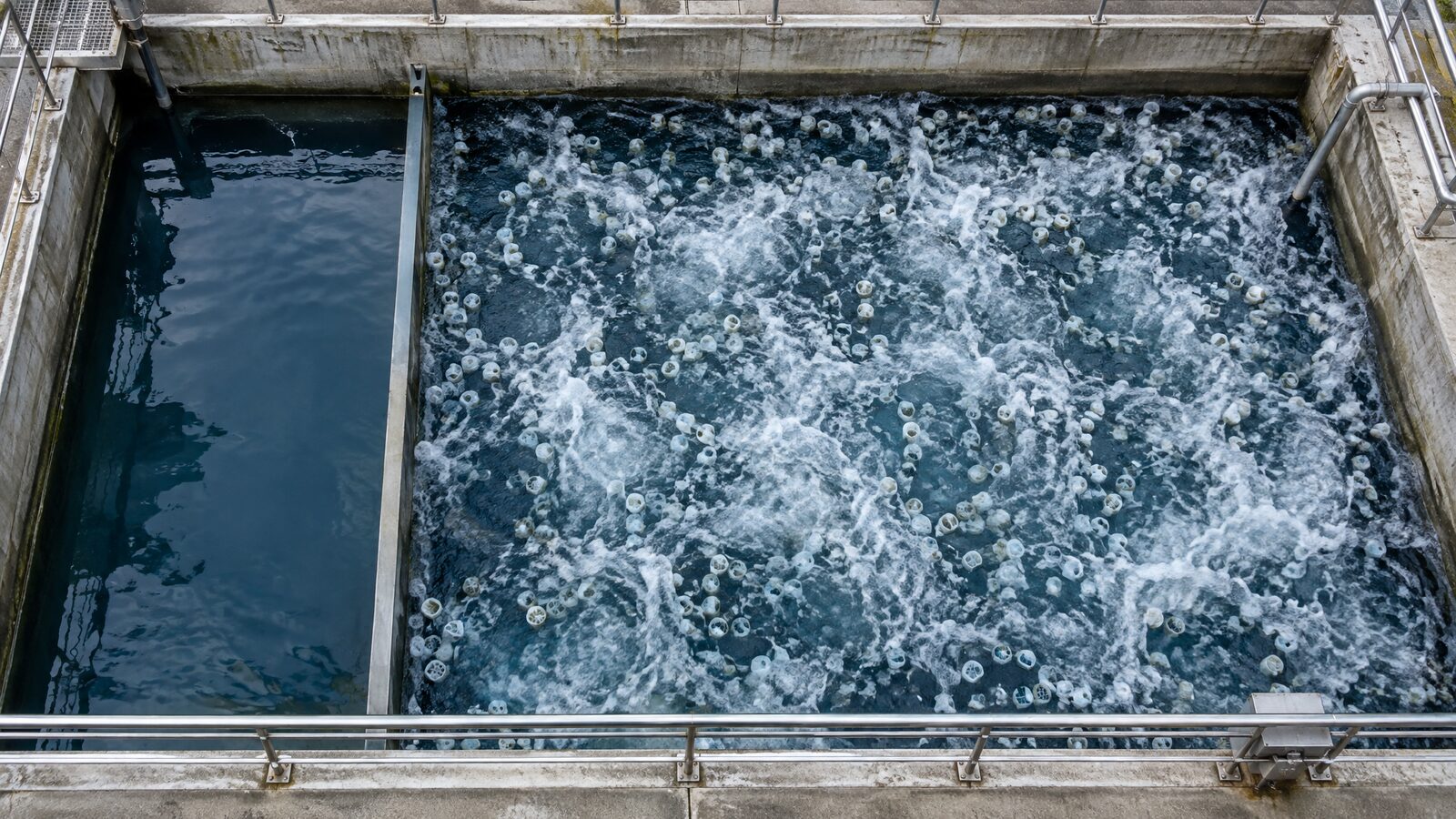
A Moving Bed Biofilm Reactor (MBBR) is a biological wastewater treatment process in which thousands of small, free-moving plastic biofilm carriers are suspended inside an aerated reactor. Microorganisms colonize the protected internal surfaces of these carriers, forming a robust biofilm that degrades organic matter (COD/BOD), oxidizes ammonia (nitrification), and can remove nitrogen through staged anoxic-aerobic configurations. Unlike conventional activated sludge, MBBR does not require sludge recirculation, and its compact footprint makes it ideal for both new plants and retrofits.
What Is MBBR?
MBBR stands for Moving Bed Biofilm Reactor. The technology was developed in Norway in the late 1980s and early 1990s and has since become one of the most widely adopted biofilm-based treatment processes worldwide. The principle is straightforward: thousands of specially designed polyethylene carriers — typically with a specific gravity close to water (0.95–0.97 g/cm³) — are kept in continuous motion inside a reactor by aeration (in aerobic zones) or mechanical mixing (in anoxic zones).
Microorganisms attach to the large protected internal surface area of the carriers, forming a thin, highly active biofilm (typically 50–300 µm thick). A retention screen at the reactor outlet keeps the carriers inside while allowing treated water and detached biomass to pass through. This eliminates the need for sludge return — a critical operational advantage over conventional activated sludge (CAS).
MBBR systems can be designed as standalone biological reactors or integrated into existing activated sludge plants as IFAS (Integrated Fixed-Film Activated Sludge) configurations, where carriers are added to existing aeration tanks to boost treatment capacity without civil expansion.
How MBBR Works
Wastewater enters the MBBR reactor, where it contacts the biofilm-covered carriers. In aerobic configurations, fine-bubble or coarse-bubble diffusers supply oxygen and maintain carrier circulation. The biofilm on the carrier surfaces metabolizes dissolved organic compounds (BOD/COD) and, under appropriate conditions, oxidizes ammonia-nitrogen (NH₄-N) to nitrate through nitrification.
For nitrogen removal, a pre-anoxic zone with mechanical mixing can be placed upstream of the aerobic MBBR. In this zone, denitrifying bacteria on the carriers reduce nitrate (NO₃-N) to nitrogen gas using influent carbon as an electron donor. Multi-stage configurations with internal recirculation enable total nitrogen (TN) removal.
The treated effluent leaves the reactor through a retention screen (typically wedge-wire or perforated plate, 5–10 mm openings) and proceeds to secondary clarification or direct filtration for solids separation.
Key MBBR Design Parameters
| Parameter | Typical Value | Unit | Notes |
|---|---|---|---|
| Carrier Fill Ratio | 30 – 67 | % | Volume of carriers / reactor volume |
| Protected Surface Area | 200 – 800 | m²/m³ | Effective biofilm area per carrier volume |
| Hydraulic Retention Time (HRT) | 1 – 6 | hours | Depends on application and loading |
| Surface Area Loading Rate (SALR) | 1 – 25 | g BOD₅/m²·d | Design loading on carrier surface |
| Volumetric Loading Rate | 2 – 10 | kg BOD₅/m³·d | Reactor volume-based loading |
| Dissolved Oxygen (aerobic) | 2 – 6 | mg/L | Minimum 2 mg/L for nitrification |
| Biofilm Thickness | 50 – 300 | µm | Self-regulating through shear |
| Temperature Range | 5 – 35 | °C | Nitrification rate drops below 10°C |
MBBR Applications
Municipal Wastewater
Secondary treatment, nitrification, tertiary polishing and nutrient removal at WWTPs.
Industrial Pretreatment
High-COD/BOD treatment for food, dairy, brewery, pharmaceutical and petrochemical industries.
Retrofit & Capacity Upgrade
Increase biological capacity of existing activated sludge plants without building new tanks.
Nitrogen Removal
Staged anoxic/aerobic MBBR trains for total nitrogen removal below 10 mg/L.
Advantages of MBBR Technology
- ✓ Compact footprint — 2–4x smaller than conventional activated sludge for the same load.
- ✓ No sludge recirculation required — simplifies operation.
- ✓ Resilient to shock loads and toxic events due to protected biofilm.
- ✓ Easy retrofit into existing tanks — no additional civil works needed.
- ✓ Modular and scalable — adjust fill ratio or add carriers to increase capacity.
- ✓ Low biomass production compared to CAS — reduces sludge handling costs.
- ✓ Suitable for cold climates — biofilm is less affected by temperature than suspended growth.
Limitations
- × Requires downstream solids separation (clarifier or filter) for detached biomass.
- × Aeration energy can be higher than CAS at low loading rates due to carrier agitation needs.
- × Carrier retention screens require maintenance and cleaning.
- × Not inherently suited for biological phosphorus removal (chemical dosing may be needed).
- × Carrier cost represents a significant capital investment.
MBBR System Components
A complete MBBR system consists of the reactor tank (typically concrete or steel), biofilm carriers (HDPE or PP plastic elements with protected surface area), an aeration system (fine- or coarse-bubble diffusers with blowers), carrier retention screens (wedge-wire or perforated plate sieves), and downstream separation (secondary clarifier, DAF, or disc/drum filter). Process instrumentation includes dissolved oxygen probes, pH sensors, and ammonia analyzers for automated control.
MBBR vs. Activated Sludge — Quick Comparison
| Parameter | Typical Value | Notes |
|---|---|---|
| Sludge Recirculation | Not required | MBBR advantage |
| Footprint | 50–70% of CAS | At equivalent loading |
| Shock Load Resilience | High | Protected biofilm |
| Retrofit Potential | Excellent | Carriers added to existing tanks |
| Solids Separation | Required downstream | Clarifier or filter needed |
| Phosphorus Removal | Chemical dosing | No bio-P in pure MBBR |
Frequently Asked Questions
What does MBBR stand for?
Can MBBR be retrofitted into existing activated sludge plants?
What fill ratio is typically used in MBBR systems?
Does MBBR remove nitrogen?
What industries use MBBR technology?
Related Pages
What Is MBBR?
Definition, terminology and core process.
How MBBR Works
Biofilm, carriers, movement and aeration.
MBBR Process
Process sequence and configurations.
MBBR Components
Reactors, carriers, screens, aeration.
Biofilm in MBBR
Biofilm development and performance.
MBBR Carriers
Carrier types, function and selection.
MBBR Media
Media properties and surface area.
MBBR Aeration
Oxygen transfer and energy.
Mixing & Hydrodynamics
Media movement and reactor hydraulics.
Biofilm Thickness
Thickness, diffusion and performance.
Filling Ratio
Fill percentage and design implications.
Hydraulics & HRT
HRT, flow distribution and performance.
Need MBBR Design Support?
Submit your wastewater data for a preliminary MBBR engineering assessment. Our team reviews every submission within 2 business days.