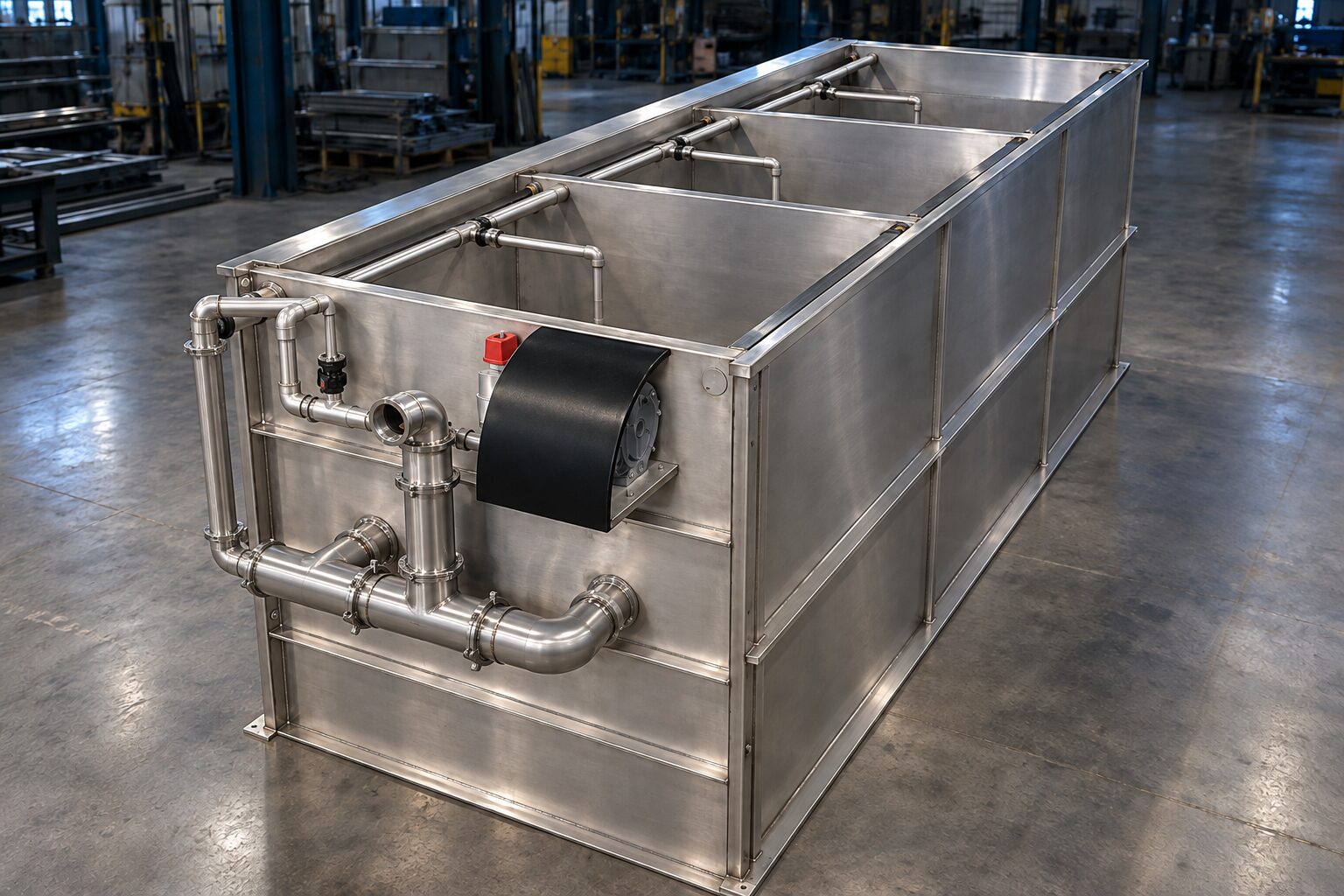
A compact MBBR tank packages the biofilm reactor — carriers, retention screens and an aeration grid — into a single small-footprint tank suited to small flows and decentralized sites. Because most of the build happens in the workshop rather than on site, installation and commissioning are faster than a constructed basin. The unit size and internals are matched to the flow and treatment target rather than supplied as a fixed catalogue item.
Where a compact MBBR tank fits
Compact units are typically considered where space is limited, where a site is remote or decentralized, or where a small plant needs reliable biological treatment without the civil programme of a constructed basin. Common situations include small municipal works, individual facilities, and sites that need dependable COD, BOD or ammonia reduction in a small package.
The same MBBR process advantages apply at small scale: a resilient fixed biofilm, tolerance to load variation, and no sludge return loop. Where flows are expected to grow, a modular tank system may be the better long-term fit — we help you compare the two during the engineering review.
Compact MBBR Tank — Configuration Choices (project-specific — confirmed per project)
| Parameter | Typical Value | Unit | Notes |
|---|---|---|---|
| Application | small flows / decentralized | — | Municipal or industrial |
| Delivery format | factory-built packaged tank | — | Minimal on-site works |
| Tank material | per configuration | — | Steel, GRP/FRP or PE/PP |
| Treatment target | COD / BOD / ammonia | — | Defined by objective |
| Sizing basis | flow + load | — | Set during engineering review |
Frequently Asked Questions
What size flow suits a compact MBBR tank?
Is a compact MBBR tank pre-built?
What if my flow grows later?
Related Pages
Find Your MBBR Solution
Tell us about your wastewater, flow and treatment objectives. We will identify a suitable MBBR configuration and the next engineering step.