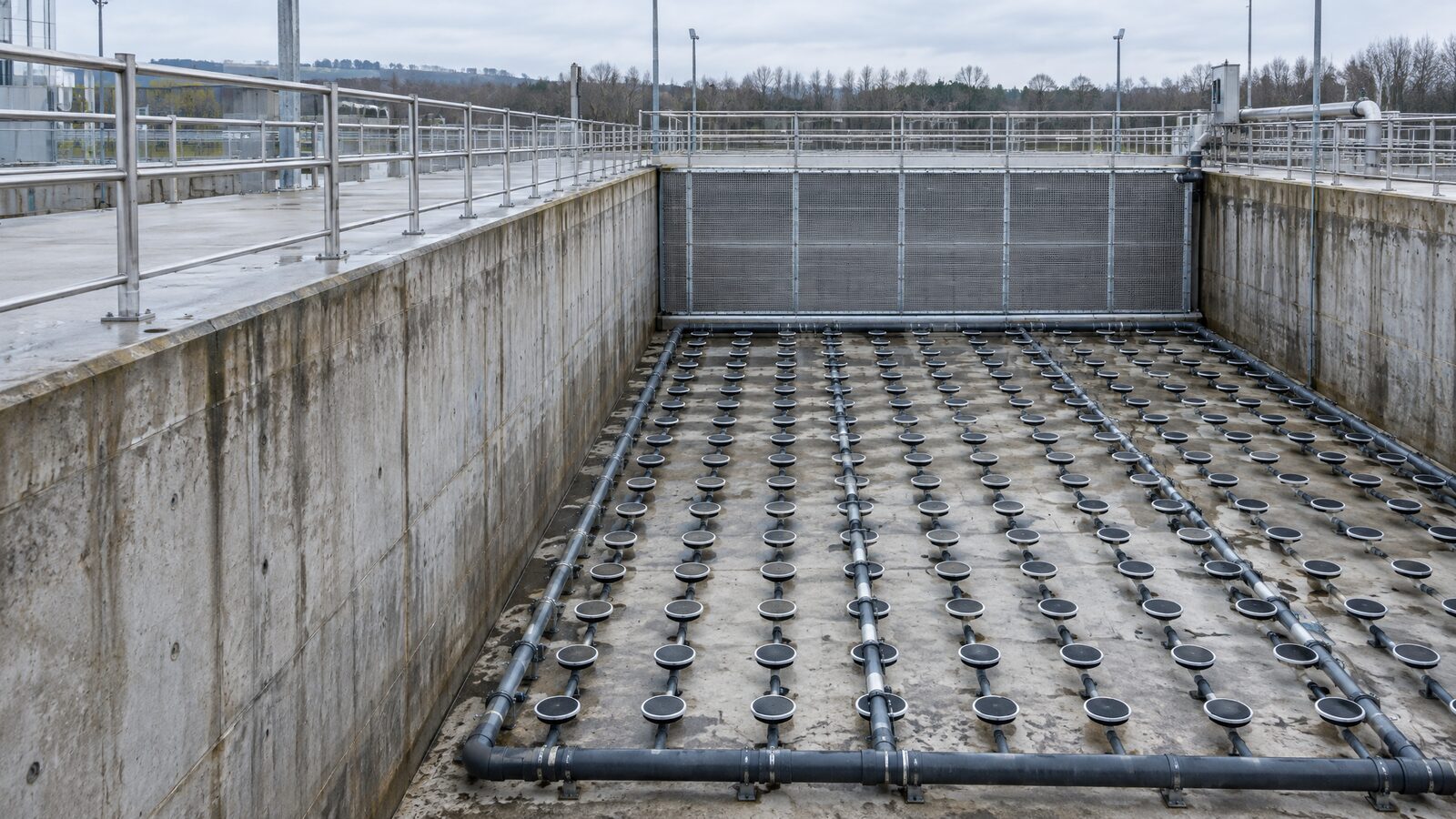
For larger flows, MBBR is frequently installed in concrete tanks — either purpose-built basins or existing structures that are converted by adding carriers, retention screens and aeration. Concrete suits substantial treatment volumes and long service life, and reusing an existing tank concentrates the investment on process equipment rather than new construction. Suitability of an existing tank depends on its depth, geometry and structural condition, which are checked per site.
New-build and conversion routes
A new concrete basin can be designed around the MBBR process from the outset — depth, staging and aeration optimised for carrier circulation. Alternatively, an existing aeration basin or redundant tank can often be converted, which reuses the largest and longest-lead item in a treatment plant. Both routes deliver the same fixed-film benefits at scale.
Which route fits your project depends on whether suitable tankage already exists and on your capacity and programme — we assess this during the engineering review, alongside our retrofit resources.
Concrete Tank MBBR — Configuration Choices (project-specific — confirmed per project)
| Parameter | Typical Value | Unit | Notes |
|---|---|---|---|
| Route | new-build or conversion | — | Depends on existing tankage |
| Scale | larger municipal / industrial | — | Substantial volumes |
| Reactor internals | carriers + screens + aeration | — | Added to the tank |
| Existing-tank checks | depth / geometry / condition | — | Verified per site |
| Sizing basis | flow + load | — | Set during engineering review |
Frequently Asked Questions
Can an existing concrete tank be converted to MBBR?
When is a new concrete tank preferred?
Why use concrete for larger MBBR plants?
Related Pages
Find Your MBBR Solution
Tell us about your wastewater, flow and treatment objectives. We will identify a suitable MBBR configuration and the next engineering step.